Search this site
Showing posts with label Opinion. Show all posts
Wednesday, 10 February 2016
Yen Strength Hurts Corporate Japan
By Kathy Lien, Managing Director of FX Strategy for BK Asset Management.
Markets are falling and the yen is rising. Since the beginning of the month, the Japanese yen is up more than 5% against the U.S. dollar. The yen is a funding currency and it's falling hard as investors bail out of risky trades. In fewer than 7 trading days, USD/JPY has fallen 700 pips and it is not because the market is optimistic on Japan’s economy. In fact, yen strength comes at significant costs for Japan because as an export-dependent nation, many Japanese industries
live and die by the yen's val
ue. While smart corporations hedge their yen risk, they are slow to do so and can only hedge a certain percentage of yen gains.
So yen strength hurts corporate profitability and, in turn, the economy. In the context of global market volatility and the overall weakness of Japan’s economy, many investors are wondering if the Bank of Japan will intervene to halt the slide in its currency.
The last time the Ministry of Finance ordered the BoJ to intervene was in 2011, after the earthquake and tsunami. The Bank of Japan was very active in the market between 1999 and 2004, but most intervention happened below 110. However between 2003 and 2004, they would buy dollars and sell yen anywhere between 120 and 105 in a desperate attempt to help exporters as the economy struggled with zero growth and deflation. For the better part of 2015, Japan’s economy saw positive growth, but in the fourth quarter, GDP growth is expected to turn negative once again. Inflation remains extremely low and the yen has risen significantly since the BoJ cut interest rates, giving the Japanese government plenty of reasons to intervene. Japanese officials have begun to check prices and warn that they are monitoring the markets closely. Their line in the sand is 115 so if USD/JPY falls any further, the Japanese government could step up to the plate. But for now, they're waiting on 2 things -- the market’s response to Janet Yellen’s testimony and CFTC data on speculative yen positioning.
There’s a lot weighing on Yellen’s shoulders Wednesday because now more than ever, investors are looking for her guidance. The recent sell-off in the dollar, decline in Treasury yields and collapse in the stock market reflect concerns about the U.S. economy and Fed policy. A number of central-bank officials have suggested that rates could remain steady next month and the big question is whether the Fed Chair shares these views. Had Friday’s labor-market report not shown an improvement in the unemployment rate and faster wage growth, we would say Yellen had no choice but to prepare the market for no changes next month. However with 5 weeks to go before the next FOMC meeting, it can be argued that there’s enough strength in the economy for Yellen to keep the door to tightening next month open. While Janet Yellen appears before the House Financial Services committee at 10:30am ET on Wednesday, her testimony and the Fed’s monetary-policy report will be released at 8:30am ET -- so traders need to be prepared for an early morning move.
Tuesday's big gains in EUR/USD tell us that investors are bracing for less hawkishness. Banking troubles in Europe and soaring peripheral-bond yields have not stopped investors from buying euros. The euro is a funding currency and the liquidation of risk-on trades has involved the reversal of euro short trades. However, we are surprised by the extent of EUR/USD strength because the selling this week was sparked by European troubles. Just as the yen's rise will hurt Japan’s economy, the jump in peripheral yields could come back to haunt the euro. Along these lines, the appreciation in the currency also increases the pressure on the ECB to ease, especially following the sharp decline in German industrial production. Investors were looking for a 0.5% increase but IP fell -1.2%.
The British pound also traded lower versus the greenback despite a narrower trade deficit. There’s no question that U.K. exports have been hit hard by weaker European and Chinese growth. However EUR/GBP appreciated more than 10% over the past 2 months, which is extremely stimulative for the U.K. export sector. With no major U.K. economic reports scheduled for release this week, the outlook for sterling will be determined by the market’s appetite for U.S. dollars.
Meanwhile, oil prices continued to fall with WTI Crude dropping 4% to $28.50 a barrel. The day started with strong gains in oil but the turnaround during the North American trading session put USD/CAD on a rollercoaster. Part of the volatility was caused by the Energy Information Administration’s lowered forecast for oil -- it now estimates WTI crude at $37.59 a barrel instead of $38.54. USD/CAD ended the day unchanged but the recent moves in oil suggest that USD/CAD should be trading above 1.40.
Finally, AUD and NZD recovered earlier losses to end the day with only minor losses. While New Zealand house prices grew at a slower pace and Australian business conditions deteriorated, AUD and NZD have been largely driven by risk appetite.
Labels:
Opinion
Saturday, 30 January 2016
Yen Tanks, Here's What To Expect Next Week
By Kathy Lien, Managing Director of FX Strategy for BK Asset Management.
Thanks to the Bank of Japan, we’ve had a very exciting end to the first trading month of the year. 2016 started and ended with a bang after Japan’s central bank pulled out all of the stops by dropping interest rates below zero.
They have now become the 4th country with negative rates (next to Denmark, Switzerland, Sweden) and the 5th including the Eurozone. Most investors expected the BoJ to be dovish, some were even looking for more QE but they reached deeper into their toolbox and rolled out negative interest rates.
This decision took USD/JPY from 118.50 to its 200-day SMA at 121.70. A 400-pip move is typical after such a major announcement -- back in October 2014 USD/JPY jumped more than 300 pips after the BoJ surprised the market with a new round of Quantitative Easing.
On Friday, they not only lowered interest rates, but also pushed out their timeline for reaching their inflation target and warned that more actions could be taken including changing the quantity and quality of asset purchases as well as cutting rates further. Since the BoJ did not increase the size of its QE program, this could be the next option if the economy weakens further. But adopting this radical form of monetary policy is a sign of the country’s desperation. They are finally recognizing the negative impact that volatility in the financial markets, the sharp decline in inflation and the slowdown in China will have on Japan’s economy.
In Thursday’s note, we talked about how much Japan’s economy deteriorated since the December meeting, but the drop in the Nikkei, rise in the Yen and speculative positioning also played a big role in the BoJ’s decision. Looking ahead, the yen should be sold on rallies.
Next Week: 8 Major Event Risks
- Chinese PMI
- UK PMI
- RBA Rate Decision
- German Labor Report
- NZ Labor Report
- BoE Rate Decision and Quarterly Report
- US Nonfarm Payrolls
- Canadian Employment Report
Although U.S. nonfarm payrolls is the most high-profile report on next week’s calendar, we find Australia and the U.K.’s monetary policy announcements far more interesting because after the BoJ’s actions, everyone is wondering who will be next.
Neither the RBA nor the BoE are expected to change monetary policy but a dovish bias from both could drive AUD and GBP lower. With the Chinese economy slowing and commodity prices falling, it may be difficult for the RBA to maintain a brave face. AUD and NZD traded lower Friday but we believe that those rallies will fade soon. China’s official PMI report is not expected to be particularly ugly, as the government will do everything in its power to prevent further losses in equity markets.
The Bank of England on the other hand has every reason to lower its inflation forecasts and signal to the market that interest rates may not increase until the end of the year at the earliest. Given the sharp fall in retail sales and trade activity in the fourth quarter, we are still surprised by the uptick in GDP. We prefer to put greater weight on Bank of England Governor Carney’s dovish comments and the likelihood of the BoE minutes and Quarterly Inflation report echoing that tone. GBP/USD traded lower Friday and we are looking for further losses in the currency pair.
Of course the focus will also be on the U.S. dollar because not only do we have the employment report at the end of the week, but also personal income and spending, ADP and the ISM manufacturing report on the calendar. However with all of the other Tier-1 economic reports scheduled for release and the lack of the ISM non-manufacturing index, don’t expect the dollar to capture the market’s attention until Thursday. Also a weak nonfarm payrolls report will have a larger impact on the greenback than a strong one because it will reinforce the market’s suspicion that Federal Reserve shares the concerns of other major central banks. Friday’s BoJ decision and the ECB’s recent dovishness puts significant pressure on the Fed to delay tightening, even though personal consumption growth accelerated according to the fourth quarter GDP report. Growth slowed to 0.7% from 2% at the end of last year, which was slightly worse than expected. But considering that investors braced for an even weaker release, it was good enough to prevent a significant drop in USD/JPY.
USD/CAD traded lower Friday on the back of stronger GDP numbers and higher oil prices. Canada’s economy expanded 0.3% in November up from 0% the month prior but the real key is oil, which continues to show signs of a bottom -- but 1.40 is proving to be a key level for USD/CAD. Like the U.S., Canada has employment and manufacturing PMI numbers scheduled for release next week. Both of these reports will be out on Friday, which means that for most of the week, USD/CAD will be driven by the oil.
Finally, we bumped the euro down to the bottom of Friday’s report because EUR/USD has been the most boring pair to trade. It has remained stuck in a narrow 1.0700 to 1.10 trading range and is likely to be bounded by these levels for some time. The decline in German consumer consumption, drop in French CPI and slowdown in French GDP growth was completely overshadowed by the BoJ’s rate decision. The euro did not benefit from the improvement in risk appetite, which should not surprise our readers because the currency behaved exactly the same way in October 2014. Compared to other major economies, the Eurozone has a lighter economic calendar with less market-moving data. German unemployment numbers are the main release along with revisions to PMIs.
Labels:
Opinion
Wednesday, 27 January 2016
Weaker USD Ahead Of FOMC On Speculation Of Less-Hawkish Statement
Instead of showing a sustained break below the 1.42-mark the British pound bounced off the 1.4170 level and surged to a high of 1.4366. While there could be some upside room before GBP approaches technical resistance levels at 1.44 and 1.4470, we generally favor a bearish stance in the GBP/USD. As long as the Brexit uncertainty persists, the risk is to the downside. Moreover, BoE governor Carney has taken a cautious tone at a hearing Tuesday, saying that policy makers "have to see a continued firming of core inflation" in order to raise rates. Economists are forecasting no change to interest rates in 2016.
The euro ended the day unchanged against the U.S. dollar and it looked as if the EUR/USD was waiting for today's FOMC statement to determine direction. All eyes will be on the Federal Reserve's policy statement at 19:00 GMT.
The Fed holds its first monetary policy meeting in 2016 and while the Fed is widely expected to leave interest rates unchanged this month, the focus will be on the central bank's statement. Market participants will be looking for clues about the Fed's forward guidance and whether policy makers are backing away from the path of four rate hikes this year. Speculations are the Fed will signal a more cautious approach to raising interest rates this year, taking a less hawkish monetary policy stance. In case of a less-hawkish bias the U.S. dollar could weaken in the short-term, driving the euro and pound sterling sharply higher. The expectations are high and if the FOMC statement will be left essentially unchanged, maintaining a steady stance, market participants could be disappointed and refrain from adding to their positions. With no new insights into the Fed's monetary policy path the statement could thus turn out to be a non-event for traders.
We will wait and see and focus on the technical side.
EUR/USD
Based on an ascending triangle in the 4-hour chart the odds are currently in favor of upcoming bullish momentum. We will focus on an upside break of 1.0875, driving the pair towards 1.0920 and 1.0955. Upward movements could be limited until the resistance line which is currently at 1.0955/60. The ascending-triangle-pattern shall become void if the euro declines below 1.0830. How the currency pair will trades within the next 12 hours will mainly hinge on the outcome of the FOMC announcement but in case of a possible sell-off, traders should set their targets at 1.0780 and 1.0735.
EUR/USD 4-Hour Chart
GBP/USD
The currency pair is pointing upwards and now it will be interesting whether the cable is able to break above 1.4370 and head towards higher levels at 1.4420 and 1.4470. On the bottom side bearish movements could be limited until 1.4225/20.
GBP/USD 4-Hour Chart
Here are our daily signal alerts:
EUR/USD
Long at 1.0880 SL 25 TP 35, 70
Short at 1.0830 SL 25 TP 20, 45
GBP/USD
Long at 1.4375 SL 25 TP 30, 90
Short at 1.4290 SL 25 TP 50
We wish you good trades and many pips!
Any and all liability of the author is excluded.
By MaiMarFX
Labels:
Opinion
Saturday, 23 January 2016
3 Central-Bank Meetings, 3 Reasons To Worry
By Kathy Lien, Managing Director of FX Strategy for BK Asset Management.
What a week it has been in the foreign-exchange market! The turnaround in oil, recovery in currencies and rebound in global equities has many investors hoping that 3 weeks into the New Year, we've finally seen a bottom. 2016 started with major losses across the financial markets and even with the latest bounce, oil prices are down more than 28%, U.S. stocks are down +6%, European stocks are down anywhere between 5% to 7% while Japanese stocks have lost 10% year to date. Currencies fared better as the latest recovery left most of the majors with an average of 2% to 5% in losses versus the U.S. dollar. But the question is, has the selling finally come to an end?
The answer, simply, is 'No'.
There are rallies in every bear market and most importantly nothing significant changed over the past week. Of course most markets are not in bear territory, which is typically defined by a more than 20% drop from a recent high. But many markets are oversold and a short-term recovery is not unusual. Iran is still poised to add 500,000 barrels a day to oil exports and supply far exceeds demand. Oil prices fell hard and fast over the past week and finally found some support near $25 a barrel. There was no specific reason to catalyze the rally but it was enough to drive up equities and currencies. While the Bank of Canada's optimistic attitude was a valid reason for the rise in the Canadian dollar, the decline in oil prices will certainly weigh on economic activity in the coming year.
Looking ahead, it will be another busy week for currencies.
Three central banks are scheduled to make monetary policy announcements, giving FX traders 3 reasons to be worried.
The Federal Reserve's monetary policy meeting will be the most important event risk of the week. Coming off the heels of a 25bp rate hike, no one expects another round of tightening in January. However after last month's meeting, Yellen expressed confidence in the economy and the possibility of inflation returning to 2% once transitory factors fade. This time around, it will be difficult for Federal Reserve officials to keep a brave face. While Yellen will not be holding a press conference, we would be surprised if the FOMC statement did not contain a tinge of concern.
The ECB with its weak currency is worried about inflation and economic uncertainty. The same is true of the BoE, so it's hard to believe that U.S. policymakers haven't been unnerved by the volatility in equities and commodities. The big question is whether these concerns appear in this month's FOMC statement and if they do, USD/JPY will give up its recent gains.
However USD/JPY faces the small-but-significant risk of additional easing from the Bank of Japan. According to one of the country's largest papers, Nikkei, the BoJ "is taking a serious look at expanding its monetary easing measures amid market uncertainty." They note that the central bank is worried about falling oil prices, a rising currency and tumbling stocks. While the decline in oil makes oil imports less expensive, it also makes it more difficult to achieve their inflation target. But throughout last year, despite widespread calls to do so, the central bank refused to increase the size of its Quantitative Easing program. But what's different now is that the yen is rising and stocks are falling. We're not sure if there is enough support for more stimulus, but there's no question that the BoJ will be discussing the option.
We are not looking for the Reserve Bank of New Zealand to cut interest rates again after just doing so in December. However there's a reasonable chance that it will shift its forward guidance. At the end of last year, the RBNZ said it "expect[s] to reach their inflation goal at current rate settings." That line implies that it is not looking to lower rates again in the near term, which is reinforced by its upgraded 2016 GDP forecasts. However since then we've seen dairy prices fall and CPI match the 2008 decline, which was the largest since 1998. The markets also went haywire in December, so it's likely that this month RBNZ Governor Wheeler will emphasize the possibility of further rate cuts.
Softer Eurozone PMI numbers drove the euro lower against the U.S. dollar on Friday. Manufacturing and service-sector activity slowed in January bringing the Eurozone's composite index down to 53.5 from 54.3. After Mario Draghi's strong signal to the market that additional easing could be delivered in March, the path of least resistance for EUR/USD will be lower. However it may be more of a slow drift than a steep decline. He couldn't be any clearer when he said the ECB has the power, determination and willingness to act with plenty of instruments at its disposal. Germany's IFO report is the only significant piece of Eurozone data on next week's calendar and given Friday's drop in the PMIs, we are looking for softer numbers that should take the euro lower.
Sterling traded sharply higher against the U.S. dollar Friday despite weaker retail sales numbers. Consumer spending dropped 1% in December, which was significantly weaker than the market's -0.3% forecast. Excluding auto fuel, spending still fell -0.9%. These numbers subtract from GDP growth and put the risk of next week's report to the downside. While investors ignored the news, choosing instead to focus on borrowing data, which came in much better than expected, we believe that sterling remains a sell on rallies because of the deterioration in spending, slowdown in wage growth and less hawkish BoE comments.
Finally, after rising for 12 trading days in a row, USD/CAD dropped for the third straight day. Friday's Canadian economic reports were mixed. Canadian retail sales jumped 1.7%, which was much better than anticipated, but consumer prices fell 0.5%. Ultimately we think these numbers are good for Canada because the retail sales surprise was much larger than CPI, which bodes well for next week's GDP report. Between the Bank of Canada's optimism, the whopping 8% recovery in oil prices and stronger CAD retail sales, we are looking for USD/CAD to test 1.40.
Labels:
Opinion
Friday, 22 January 2016
Draghi Drives Euro Lower
ECB President Draghi has sent the euro back down into the lower end of the recent range as he gave a strong signal that additional action could be delivered as early as March, the next meeting. The euro had approached the upper end of its range yesterday and now is slipping through $1.08.
Draghi embraced and defended the ECB's action but clearly and unequivocally opened the door wide for more action. By indicating that rates will remain at current low level of lower is a signal that the -30 bp deposit rate has not exhausted room for more cuts.
He asserted that the ECB has the "power, determination and willingness" to act. This is important because some have argued that the mild action in December meant that the ECB no longer had the will or means to take bolder action. Draghi is trying to refute this impression.
Moreover, Draghi argues that the downside risks have materialized in recent weeks. The worsening of the conditions requires a review and reassessment of the ECB's stance. Review is straightforward. It is evaluating the impact of the actions. The reassessment refers to deciding whether more action is needed. It is clear that Draghi thinks it is necessary.
The ECB has a mandate. He is committed to it. Draghi reiterated that the ECB will do "everything necessary to meet its mandate." The new staff forecasts that will be available in March will likely show that more effort is needed to reach its inflation mandate.
European bonds have rallied and the euro has come off on Draghi's comments. The decline in peripheral yields is particularly notable as the recent increase had warned of new fragmentation. The euro itself has been largely confined to a $1.08-$1.10 trading range since last month's ECB meeting.
There have been a few false breaks (moves outside the range that have not been sustained). A trendline drawn off the early December low (~$1.0525) and the low from earlier this month (~$1.0710) comes in on Thursday just below $1.08. Given the volatility of the global asset markets and growing conviction that the Fed will not lift rates in March makes us wary of another false break.
By Marc Chandler
Labels:
Opinion
Euro To Fall As ECB Preps For More Easing
By Kathy Lien, Managing Director of FX Strategy for BK Asset Management.
The biggest story in the Thursday's foreign-exchange market was ECB President Mario Draghi’s surprisingly dovish comments on monetary policy. Many economists believed he would avoid making specific comments about more policy action but as we pointed out in yesterday’s note, the 3-cent rise in the euro and decline in oil prices since December encourages the ECB head to be characteristically dovish. But on Thursday he went one step further by saying that the central bank “will possibly reconsider its policy stance in March.” Draghi could not be any clearer in suggesting that they may increase stimulus at the next meeting (there is no meeting in February) and for this reason we believe the euro should trade lower. He said the ECB has the power, determination and willingness to act with plenty of instrument at their disposal. Even though economic activity improved in December, recent market developments give the central bank many causes for concern. The ECB is worried about the volatility in commodity markets, the geopolitical landscape and the slowdown in emerging markets. Oil prices are 40% lower than when they last released their economic projections -- and that decline puts inflation at very low and even negative levels according to Draghi.
We see a 90% chance of ECB easing in March. Draghi’s desire to be “vigilant” on the risks of a downward price spiral and his resistance to “surrendering to global factors” tell us that the central bank doesn’t want to be caught behind the curve. That 10% chance of no change will only occur if oil prices suddenly rocket higher or China sweeps in with a major stimulus program that turns risk appetite and the markets around. Of course, how much easing the central bank offers is up in the air. In December they under-delivered when they failed to lower the deposit rate and increase the amount of bonds purchased -- the 2 obvious options they could employ in March. From now until March 10, the euro will be a 'sell on rallies'.
Thursday's biggest mover was the Canadian dollar, which lost more than 1.5% of its value versus the greenback. After rising for 12 straight trading days, we have now seen the strongest reversal in at least 3 months and we’re calling this a near-term top in USD/CAD. Between the Bank of Canada’s optimism, the more than 6% intraday recovery in oil prices and the prospect of stronger Canadian data on Friday, we are looking for USD/CAD to test 1.40. Canadian retail sales and consumer prices are scheduled for release Friday. While economists are looking for muted reports, the sharp rise in wholesale trade and jump in the price component of IVEY PMI points to stronger numbers.
With so many big stories outside of the U.S., it's not surprising to see mixed performance in the U.S. dollar. The greenback traded higher versus the Japanese yen, euro and Swiss franc but struggled against the British pound, Canadian, Australian and New Zealand dollars. At the start of the week we said the dollar would not be a focus due to the lack of market-moving data. Thursday morning’s mixed U.S. economic reports had very little impact on the dollar. Jobless claims rose to a 6-month high but continuing claims extended their slide. The Philadelphia Fed index came in better than expected printing at -3.5 versus a -5.9 forecast. Markit Economics’ manufacturing PMI report is scheduled for release Friday along with existing home sales. We don’t expect either of these reports to have a significant impact on the U.S. dollar.
Sterling is in play Friday with U.K. retail sales scheduled for release. After falling to a fresh 5-year low of 1.4081, GBP/USD recovered strongly during the North American trading session to end the day virtually unchanged. Economists are looking for spending to fall, which would be in line with slowing wage growth, but fewer jobs were lost according to the most recent report and the British Retail Consortium reported a small uptick in spending after the sharp fall in November. So Friday’s report may not be as weak as feared.
The prospect of more easing from the ECB has made higher-yielding currencies such as the Australian and New Zealand dollars more attractive. Both AUD and NZD rose more than 1% against the U.S. dollar and the euro. Data from New Zealand was better than expected with consumer confidence rising in January and business manufacturing activity accelerating. In Australia, however, job ads grew at a slower pace in December, consumer inflation expectations eased in January and new-home sales fell by a smaller amount. No economic reports are scheduled for release from either country on Friday so keep an eye on commodity prices.
Labels:
Opinion
Thursday, 21 January 2016
A dovish Draghi empowers Euro bears
Euro bears received ample encouragement during trading on Thursday following Mario Draghi’s very dovish rhetoric towards the health of the Eurozone economy and this consequently sent the EURUSD sinking to fresh daily lows at 1.078 as of writing. In the press conference Draghi highlighted that slowing global growth and emerging market weakness has left the Eurozone exposed to downside risks, while plunging oil prices sabotaged the Eurozone’s 2% medium-term inflation target. Although it was widely expected that the ECB would remain on standby and keep rates unchanged today, the renewed optimism over the possibility of further QE amid the aggressive decline in oil prices has provided bearish investors with a chance to attack the EUR. The bearish sentiment towards the Euro has received reinforcement today and more downside may be expected as investors bet on the likelihood of the ECB unleashing further stimulus measures in March.
WTI gearing for a potential decline The recurrent theme of an unrelenting oversupply of oil in the global markets has provided a foundation for bears to ruthlessly attack oil prices towards near 13 year lows at $27.60 during trading on Wednesday. This week has offered nothing but pain, with Iran’s sanction relief only intensifying the anxieties that oil markets could drown in oversupply and this has rapidly faded any opportunity of a recovery in value. Sentiment towards oil is immensely bearish and heightened concerns around the IMF slashing global growth forecasts, combined with China woes have boosted speculations that global demand may be fading. With ongoing geopolitical tensions between Saudi Arabia and Iran reducing any expectations around OPEC amicably cutting productions anytime soon, investor attraction towards WTI remains haunted and this should pressure prices further. From a technical standpoint, WTI is heavily depressed and a breakdown below $27.60 should encourage a further decline towards $25.
To read more market analysis from FXTM please visit: ForexTime
Disclaimer: The content in this article comprises personal opinions and ideas and should not be construed as containing personal and/or other investment advice and/or an offer of and/or solicitation for any transactions in financial instruments and/or a guarantee and/or prediction of future performance. FXTM, its affiliates, agents, directors, officers or employees do not guarantee the accuracy, validity, timeliness or completeness of any information or data made available and assume no liability as to any loss arising from any investment based on the same.
Risk Warning: There is a high level of risk involved with trading leveraged products such as forex and CFDs. You should not risk more than you can afford to lose, it is possible that you may lose more than your initial investment. You should not trade unless you fully understand the true extent of your exposure to the risk of loss. When trading, you must always take into consideration your level of experience. If the risks involved seem unclear to you, please seek independent financial advice.
Labels:
Opinion
Wednesday, 20 January 2016
EUR/USD Strategies
By Al Brooks
Nothing has changed in the EUR/USD. It is in a tight trading range on the daily chart at the apex of a 7-week trading range. This is breakout mode, and until there is a breakout, day traders will scalp. The December 3 reversal was strong enough so that the odds of a 2nd leg up are still greater than the odds of a break below the December low. Traders on the 60-minute chart are scalping for 50 pips. Traders using the 5-minute chart have been mostly scalping for 10 – 20 pips. However, there was a bigger swing down over the past 5 hours. It dropped back to the middle of the range of the past several days and it is more likely to go sideways once again. The swing down overnight lacked consecutive big bear trend bars. Many bars overlapped and had small bodies and prominent tails. This is trading range price action, and it makes the selloff more likely just another leg in the trading range rather than the start of a move with much more to go.
Labels:
Opinion
Tuesday, 19 January 2016
Chinese GDP Falls Again: This Trend is Not a Friend
- Chinese GDP came in lower yet again, printing at 6.8% after last quarter’s first fall below 7% for the first time since the financial collapse.
- Chinese stocks caught a strong bid last night after the bad news with aggressive price action, with the deductive response of investors increasing expectations for additional stimulus out of China.
- Investors appear to be using this run higher on the morning to sell at better prices, as weakness has begun to come into many major bourses on the early portion of the morning.
Chinese GDP has become a massively important number as the Chinese economy slows and investors attempt to get a sense of how aggressively this slowdown may be hitting. We discussed this theme back in October as Chinese GDP fell below 7% for the first time since the Financial Collapse, at which point markets around the world heated up their rallies as hopes and expectations for even more Central Bank action picked up. Just a few days after that GDP print and small-cap Chinese stocks were off to the races as fears of an Asian meltdown receded behind hopes for policy action out of Beijing.
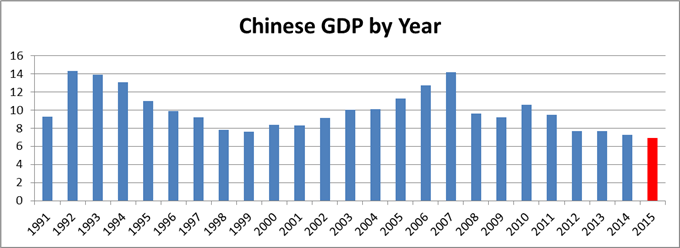
The fears around Chinese GDP are that a larger-than-expected slowdown will sucker punch the global economy to the point that global growth stalls further from its already anemic levels. Last night, we received just our most recent piece of evidence that the slowdown in China is hitting more aggressively than originally feared as Chinese GDP printed at 6.8% versus an expectation of 6.9%. And sure, we’re talking about just one-tenth of one-percent here, but as always in financial markets, the context is pertinent. The table below shows how this 6.8% print to cap off the year reflects on China’s growth in comparison to the 25 years previous:

Chart prepared by James Stanley; data derived from China NBS: National Data- GDP
China’s story really starts in 1978 when the economy was opened-up in response to mass famines that had taken place under communist rule. As the economy began to open, green shoots popped up everywhere, and from 1978 to 2013, growth averaged between 9.5-11.5%. This Chinese growth story has been called a ‘miracle,’ when a down-trodden and starving nation was converted into a productive country with a pivotal role in the progress of the global economy. Since reforms were put in place in 1978 under Deng Xiaoping, China’s GDP has increased ten-fold.
Growth rates since 1978 have been at a break-neck pace as an enormous and well-diversified geography combined with a populace of 1.3 billion people have allowed China to grow more quickly than any other nation in the history of the developed world. And this has been great for the rest of the world: As China’s grown larger and larger they’ve taken on a critical role in the growth of the world.
For a country like China, one of the easiest ways to grow is through exports. Starting off as a poor country meant that producers could build in China more cheaply than they could build at home. So production moved into China as foreign companies looked to take advantage of this dichotomy, and this type of trade is what grew China for the first 30 years after the reforms were put in place. As producers built products in China, this brought much needed capital into the country. Eventually a middle-class began to build, and now China had consumers that could actually buy some of the products that were created in the country. This is the ‘rising middle class’ that you keep hearing about, or China’s attempt to convert to a more ‘consumer-oriented’ culture. For an example of this theme in-play today, check out the article Follow the Leader: Apple, Oil to Cue Global Markets.
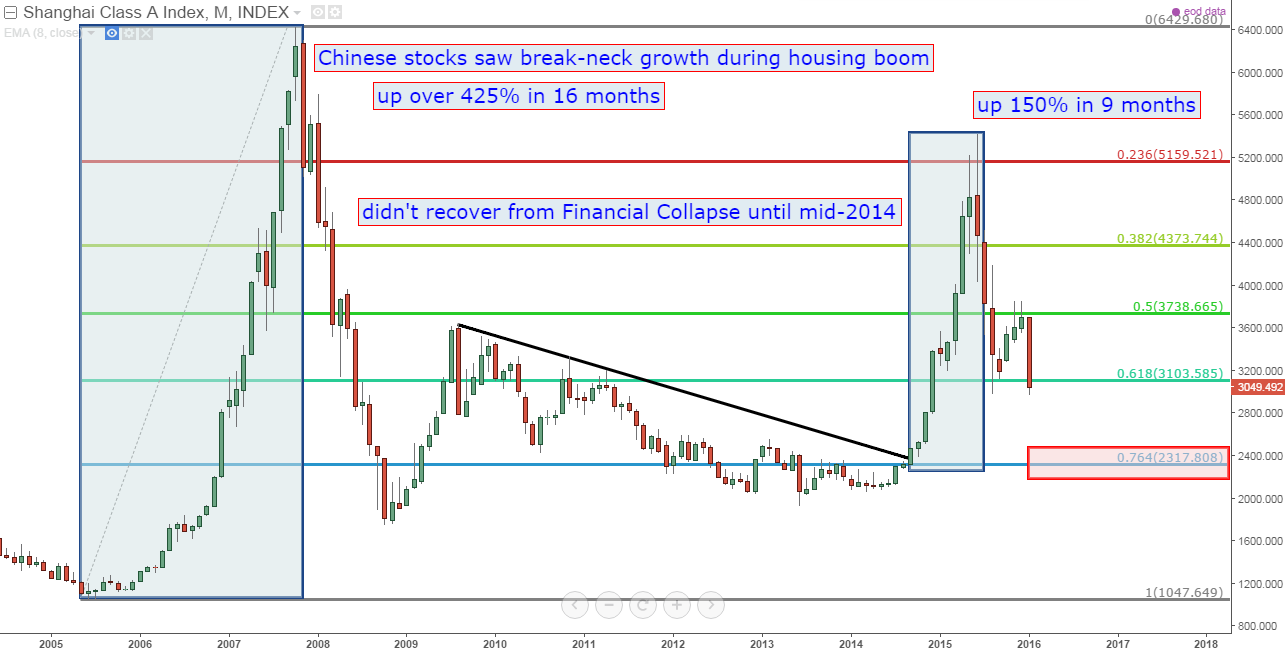
The prospect of a robust middle class is huge for the continued story of Chinese growth, because without a strong consumer-segment within the economy, China is forced to fly with global economic headwinds; facing brutal slowdowns as the world contracts and deflates and has less need to produce goods in China.
China Ebbs with Global Flows

Created with Tradingview; prepared by James Stanley
This just puts further focus on the GDP numbers being released by China so that we can get a sense of a) how aggressively the slowdown is hitting in China and b) to see how responsive the growing consumer-segment of the country is (or has been) to these economic headwinds.
The magic number for Chinese growth is 10%. From 2005-2008, Chinese GDP growth stayed above 10%, even hitting as much as 14% in 2007. The Financial Collapse was a rude move in the trend as GDP sank to just above 6%, but those growth numbers shot back up in quick order as China was back on a 12% growth rate by 2010.
But after that 12% number was hit, things have only gotten uglier. The bar has been lowered and lowered, and coming into this year the hope was for a 7% growth rate in GDP. To be sure, this is still a really brisk rate of growth that many other economies would love to see; but for China, there were some questions around these numbers.
Primarily in the way of accounting: In the United States or Europe, if something is built, it doesn’t count towards GDP until a transaction actually takes place and money exchanges hands. This makes sense, right? Because for that building to count for GDP, someone needs to buy it or lease it out to begin allowing businesses to take advantage of this newly created space.
In China, matters don’t work like that: In China, as soon as that building is built it counts towards GDP, regardless of whether or not anyone ever lives in it or buys it or even ever uses it. So China has a quick way to increase their GDP numbers with government spending projects, regardless of whether or not that building unit ever becomes contributory towards GDP.
And this is the type of thing that has many investors freaked out about a slowdown in China. Because as the economy is growing, ‘ghost cities’ can continue to be built without much concern. Investors are still buying debt, so companies and government can continue selling that debt to bring in new capital to simply build more buildings (despite the fact that nobody is living in any of them), and this still continues to stoke an already robust GDP number. But what happens when a slowdown occurs and investors are no longer rampantly buying debt and injecting capital into the economy? Not only do those ghost cities become difficult to continue financing, but keeping the economy running even at a moderate speed can become a challenge as well. And for a world that’s become immune to near-7% growth rates, how does the economy continue to grow at its breakneck pace?
--- Written by James Stanley, Analyst for DailyFX.com
Labels:
Opinion
4 Currencies In Play This Week
By Kathy Lien, Managing Director of FX Strategy for BK Asset Management.
With U.S. markets closed for Martin Luther King Day, it has been a quiet start to another busy week in the foreign-exchange market. But this week wnn't be about the U.S. dollar. There are no major U.S. economic reports scheduled for release until Wednesday and even then, CPI, the Philadelphia Fed index or housing-market numbers are not game changers for the Fed at this stage of monetary policy. We are in the quiet period, pre-FOMC, which means there will be no speeches from Federal Reserve officials. So it is no surprise that we saw zero consistency in the performance of the greenback, Monday, which strengthened versus the euro, Japanese yen, Swiss franc and New Zealand dollar. USD weakened against the British pound, Canadian and Australian dollars.
- There's enough going on in other parts of the world for the U.S. dollar to take a backseat to other currencies this week.
- If GDP growth slows to 6.8% and the other reports are stronger, we expect a limited decline in currencies and equities. However, if GDP growth slows to 6.7% or worse, investors should brace for a messy week of trading.
Euro is also in play with an ECB meeting on the calendar. No changes are expected from the European Central Bank but given how much oil prices have fallen since the beginning of the year, Mario Draghi has many reasons to remind investors that it is within the central bank's mandate to increase QE because the drop in oil makes it more difficult for the central bank to meet its 2% inflation target. If there's no recovery in oil prices before the March meeting, their inflation projections will have to be lowered in March. The question at this month's meeting is whether the will to change monetary policy has increased since the last meeting. And while we certainly believe that it has, Draghi could say that it is premature to draw any conclusions. With that in mind, we still expect him to be dovish. The ECB meets on Thursday. The German ZEW survey is scheduled for release Tuesday.
Meanwhile there has not been a down day for USD/CAD since the beginning of the year.
This is the longest stretch of strength for the currency pair since October 2008. USD/CAD climbed to a fresh 12-year high as oil prices dropped to fresh 12-year lows. Over the weekend, international sanctions on Iran were lifted, sending crude prices sharply lower. It is estimated that this groundbreaking decision could increase crude exports by an average of 500,000 barrels a day this year. The return of Iranian oil to the markets will make life even worse for oil producers like Canada. The Canadian dollar is in focus this week because the Bank of Canada has a monetary policy meeting and based on oil trends and recent economic reports, we believe the economy needs a 25bp rate cut. However the Canadian dollar is falling too far too fast and that could deter the central bank from lowering rates and risking an even deeper slide in the currency.
Between the Australian and New Zealand dollars, NZD should see a bigger move than AUD this week. B
oth currencies will be affected by Chinese data but there are no major Australian economic reports on the calendar whereas New Zealand has a dairy auction Tuesday followed by consumer prices. Dairy prices fell at the start of the year and if they do not rebound on Tuesday, we could see renewed losses in the currency as investors start to wonder if the prior downtrend has returned. The recent decline in food prices also means that inflation eased in the fourth quarter. Weaker economic reports would validate the double-top formation in NZD/USD.
Labels:
Opinion
USD/JPY – U.S. Dollar Improves, Pushes To 118
By Market Pulse
The US dollar has rebounded this week, erasing most of the losses the greenback sustained on Friday. USD/JPY had dropped all the way to 116.50, its lowest level since August 2015. The yen took full advantage of mostly downbeat US economic reports. Core Retail Sales and Retail Sales both posted declines of 0.1%, pointing to weakness in consumer spending, a key driver of economic growth.
The safe-haven yen has benefited from jittery investors, as China continues to show signs of slowdown. Chinese GDP for the fourth quarter showed another drop, as the key indicator dipped to 6.8%, shy of the forecast of 6.9%. GDP for 2016 came in at 6.9%, the weakest gain in 25 years. At the same time, Japanese fundamentals have not kept pace with US numbers, and the Bank of Japan remains under strong pressure to increase monetary easing and kick-start the struggling Japanese economy. Such moves by the BOJ would likely weaken the Japanese yen.
With the Fed finally pressing the rate trigger in December, the markets are looking for hints of the timing of the next interest rate increase. A rate hike at next week’s policy meeting is not considered likely, coming so soon after the December move. A hike by the Fed in March is more probable, although this is contingent on a strong US economy. Although the economy is in good shape, one major area of concern is the inflation picture. Inflation levels have not kept up with other economic indicators and remain at low levels. Another concern is a lack of wage growth, despite a robust labor market. The Fed will be keeping a close eye on Wednesday’s CPI reports, and it’s a safe bet that policymakers will want to see stronger inflation numbers before signing on for another rate hike.
USD/JPY Fundamentals
Tuesday (Jan. 19)
- 10:00 US NAHB Housing Market Index. Estimate 61 points
- 16:00 US TIC Long-Term Purchases
- 18:30 Australian Westpac Consumer Sentiment
Wednesday (Jan. 20)
- 8:30 US Building Permits. Estimate 1.20M
- 8:30 US CPI. Estimate 0.0%
- 8:30 US Core CPI
*All release times are EST
USD/JPY for Tuesday, January 19, 2016
USD/JPY January 19 at 8:40 EST
Open: 117.40 Low: 117.23 High: 118.11 Close: 117.99
USD/JPY Technical
| S3 | S2 | S1 | R1 | R2 | R3 |
| 113.23 | 115.45 | 116.88 | 118.53 | 119.58 | 120.40 |
- USD/JPY posted gains in the Asian session and has leveled off in European trade
- 116.88 has some breathing room in support as the pair has posted gains
- 118.53 is a weak line of resistance
- Current range: 116.88 to 118.53
- Below: 116.88, 115.45 and 113.23
- Above: 118.53, 119.58 and 120.40
USD/JPY ratio remains unchanged. Long positions continue to command a solid majority (63%), which is indicative of strong trader bias towards the pair continuing to move higher.
Labels:
Opinion
Monday, 18 January 2016
USD/JPY – Dollar Pushes Above 117
By Market Pulse
USD/JPY has started the new trading week with gains, as the pair trades at 117.40 in the Monday European session. On the release front, Japanese manufacturing releases were dismal, as both Revised Industrial Production and Tertiary Industry Activity posted declines. In the US, there are no releases on the schedule, as the markets are closed for Martin Luther King Day.
The Japanese yen posted sharp gains at the end of last week, climbing some 150 points against the dollar. USD/JPY dropped all the way to 116.50, its lowest level since August 2015. The yen took full advantage of mostly downbeat US economic reports. Core Retail Sales and Retail Sales both posted declines of 0.1%, pointing to weakness in consumer spending, a key driver of economic growth. At the same time, consumer confidence remains at high levels, as the UoM Consumer Sentiment jumped to 93.3 points, beating the estimate and posting a six-month high as well. Inflation levels, one of the sore points in a generally bright economic picture, continue to struggle. PPI, which measures inflation in the manufacturing sector, came in at -0.2%, matching expectations. Still, this marked the third decline in four months, and persistently weak inflation could delay the next Fed rate hike. There was more bad news from the manufacturing front, another trouble spot in the economy. The Empire State Manufacturing Index plunged to -19.4 points, compared to an estimate of -4.1 points.
Will the Federal Reserve make another move? The Fed raised interest rates in December for the first time in nine years, and hinted that this move was the first of a series in 2016. Not surprisingly, this has led to intense market speculation as to the timing of another rate hike. A rate hike in late January is not considered likely, coming so soon after the December move. A move by the Fed in March is more probable, contingent of course on a strong US economy. Although the economy is in good shape, one major area of concern is the inflation picture. Inflation levels have not kept up with other economic indicators and remain at low levels. The minutes of the December meeting indicated that some Fed members strongly considered voting against a rate hike due to weak inflation. Another concern is a lack of wage growth, despite a robust labor market. This was underscored by the last Average Hourly Earnings report, which came in at a flat 0.0% in December. The Fed will be keeping a close eye on inflation and wage growth data before reaching a decision to raise rates for a second time.
USD/JPY Fundamentals
Sunday (Jan. 17)
- 23:30 Japanese Revised Industrial Production. Estimate +1.4%. Actual -0.9%
- 23:30 Japanese Tertiary Industry Activity. Estimate -0.6%. Actual -0.8%
- There are no scheduled Japanese or US releases
*All release times are EST
USD/JPY for Monday, January 18, 2016
USD/JPY January 18 at 7:15 EST
Open: 117.00 Low: 116.92 High: 117.44 Close: 117.36
USD/JPY Technical
| S3 | S2 | S1 | R1 | R2 | R3 |
| 113.23 | 115.45 | 116.88 | 118.53 | 119.58 | 120.40 |
- USD/JPY posted gains in the Asian session and leveled off in European trade
- 116.88 is providing weak support
- 118.53 is the next resistance line
- Current range: 116.88 to 118.53
- Below: 116.88, 115.45 and 113.23
- Above: 118.53, 119.58 and 120.40
USD/JPY ratio is showing little change. Long positions continue to command a solid majority (64%), which is indicative of strong trader bias towards the pair continuing to move higher.
Labels:
Opinion
Subscribe to:
Posts (Atom)